In short
For an Oriental hornet nest in a shutter box, wall or the ground, I treat in the evening, when most hornets are inside, and inject the product into the nest cavity rather than spraying from outside. The entrance isn’t blocked before treatment, because the colony will open another exit, sometimes into the house. A honey bee swarm is different: usually a beekeeper collects it alive, and I’ll tell you that first.
- Size
- Oriental hornet 25–35 mm · honey bee 12–15 mm
- Sting
- A wasp stings again and again. A bee stings once, the stinger stays in the skin and the bee dies
- Where the nest is
- The Oriental hornet nests in enclosed spaces: a shutter box, a wall cavity, the ground, under a deck
- Active hours
- The Oriental hornet is most active in the hottest hours. In the evening most of them are inside the nest
- Season
- A queen founds a nest in spring, it peaks in late summer and fall, and the colony breaks up in winter
- Old nests
- An emptied nest isn’t reoccupied, but the cavity can attract a new queen
- Nest defense
- A hornet that senses a threat releases an alarm signal that calls in more hornets within seconds
- Bee swarms
- Usually rests for a few hours to a day or two on its way to a permanent home, and a beekeeper can collect it
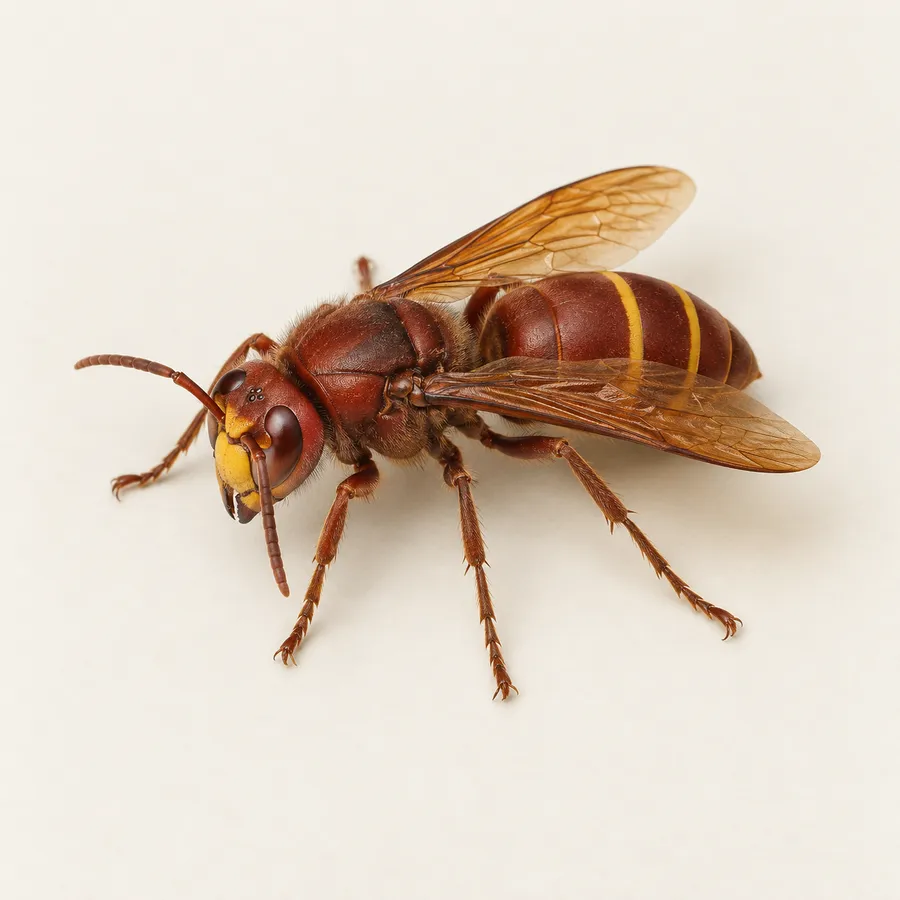
Oriental hornet Vespa orientalis
The hornet I run into on almost every call. Large, smooth and shiny, reddish brown with a wide yellow band on the abdomen and a yellow face. It goes after protein and sweets, preys on bees near hives, and turns up at trash bins, the grill and fallen fruit.
Paper wasp Polistes spp.
Slimmer and longer, 15–20 mm, with legs that dangle below its body in flight. It builds an open comb shaped like a small umbrella under an awning, on a railing or in a pergola. The colony is small and less aggressive, and a small nest far from where you sit is sometimes not urgent at all.
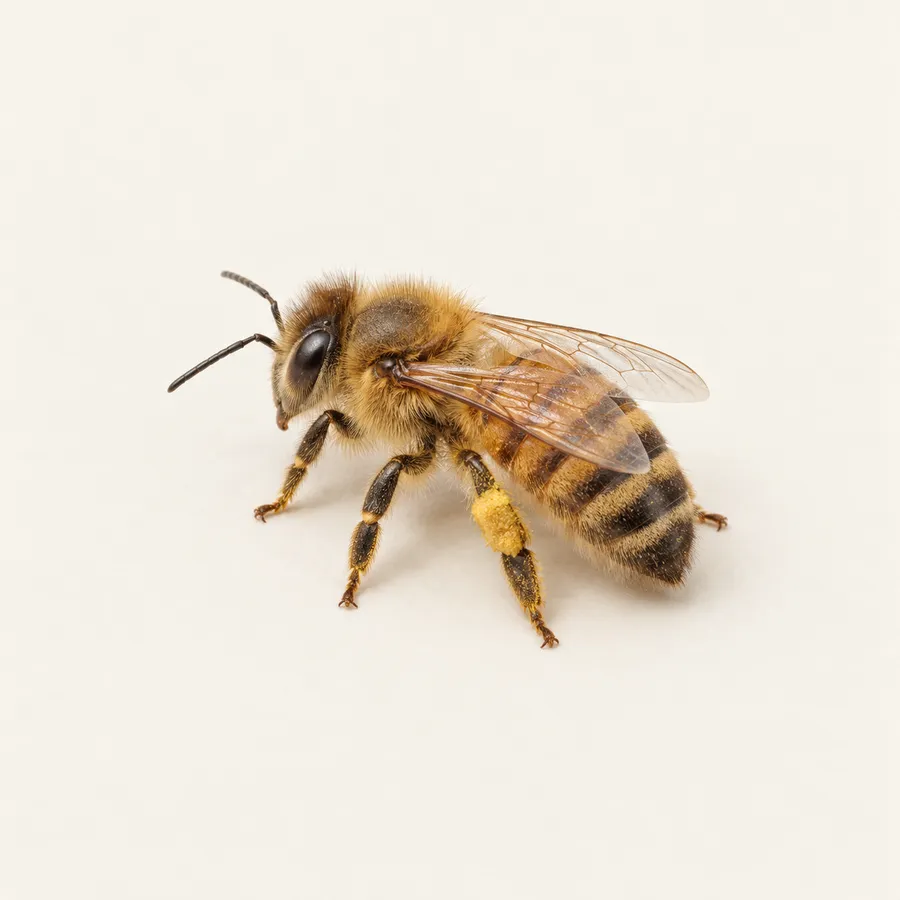
Honey bee Apis mellifera
Smaller, hairy and dusty-looking, sometimes with a yellow lump of pollen on its hind leg. Bees matter for pollination and farming, so a swarm resting on a tree or a fence is first a job for a beekeeper, and only then a question of pest control.
A single wasp that lands on the watermelon and flies off is a worker out for food, and there isn’t necessarily a nest nearby. You recognize a nest by its traffic: wasps flying in and out of the same spot again and again, in a fixed direction, for hours. These are the signs I look for:
- 1
A fixed flight line
Wasps flying in a straight line to one spot and back from it. Stand a few meters away, watch for a few minutes and note where they disappear.
- 2
Buzzing from a wall or shutter
A buzzing sound from inside the shutter box, a wall cavity or the ceiling, mostly in the hot hours. It means the nest is inside the cavity, and the wasps aren’t just passing through.
- 3
A hole in the ground with busy traffic
At the edge of a flower bed, under a shrub or near an irrigation pipe. The Oriental hornet digs its nest in the ground, and from outside all you see is a small hole and traffic that never stops.
- 4
A gray comb under an awning
A gray, paper-like structure with open cells, hanging under an awning, a railing or a pergola. That’s a paper wasp nest, and it’s in plain sight.
- 5
A cluster of bees on a branch
A dense, seething mass of thousands of bees on a branch, a fence or a box, usually in spring. That’s a swarm on its way to a new home, not a nest.
- 6
Bees going into a wall
Bees going in and out of a crack in a wall or a shutter box for weeks have already built combs there. It’s no longer a passing swarm, and it calls for a careful decision.
Most of the multiple-sting cases I hear about started with someone trying to deal with a nest on their own. When you touch the nest, the colony reacts as one body. These are the mistakes I see again and again:
Blocking the entrance
Foam, a rag or a bag stuffed in the entrance doesn’t trap the colony. The wasps open another exit, and quite often it faces inward: into a room, a closet or the ceiling cavity.
Spraying from outside
Spray on the entrance kills whatever it touches. The queen and larvae inside the cavity stay intact, and the wasps that were hit call in all the rest.
A ladder in the middle of an attack
Someone spraying a shutter box from a ladder who gets stung can fall. A fall from a ladder during an attack is one of the most serious injuries I hear about.
Water, fire and a flashlight
A garden hose angers the wasps and doesn’t reach the cavity. Fire and fuel are dangerous to the house. A white flashlight aimed at the entrance in the dark turns whoever holds it into a target.
Store-bought traps
A trap catches workers out looking for food, but doesn’t touch the queen and the larvae. Sweet bait can even draw wasps into a yard they would never have come to.
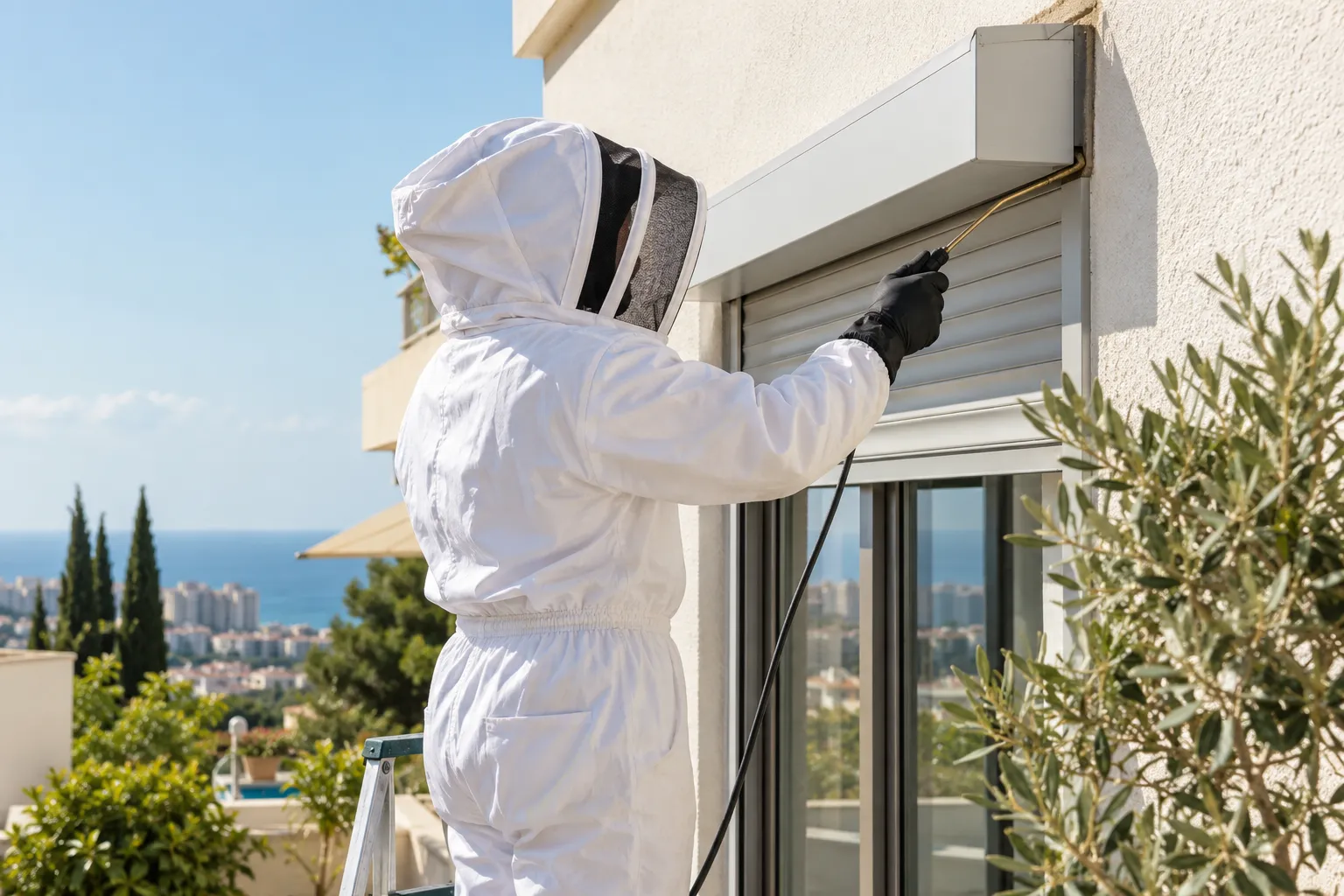
The treatment is built around one question: how to reach the whole colony, not just the wasps you see outside. And with bees, the first question is whether pest control is needed at all.
- 1
Identification: wasp or bee
From a photo or a short video I can tell whether it’s an Oriental hornet, a paper wasp or a honey bee. With bees, I refer you to a beekeeper first and explain why.
- 2
Finding the real entrance
I follow the flight lines from two angles until I know exactly where the entrance is. In a shutter box or a wall, the entrance isn’t always right next to the nest.
- 3
Treatment at the right time
I come in the evening or early in the morning, when most of the workers are inside the nest. At midday many of them are out, and they come back later to a spot that has already been treated.
- 4
The product goes into the cavity
I work in a protective suit and inject the product into the nest cavity, without spraying the wall around it. That way it reaches the queen and the larvae, and doesn’t spread around the yard.
- 5
The entrance stays open for a while
Wasps returning from outside pass through the treated entrance. I tell you how long to keep away from the area, and check that the activity has stopped.
- 6
Removal and sealing
Once there’s no more traffic, I remove what can be removed and seal the cavity, so that a new queen won’t choose the same spot next season.
Do
- Mark off the area and keep children and pets away from it
- Close the windows in the rooms near the nest
- Leave the shutter with the nest in it alone: don’t open it or close it
- Photograph or film the entrance from a safe distance and send it to me
- Show me exactly where they come out, at two different times of day
- Switch off outdoor lights near the nest the evening before
- Tell me about any beehives nearby, a pool, water bowls for animals, or anyone at home who is allergic to stings
No need
- Blocking the entrance with foam, a rag or a bag
- Spraying the nest from a ladder or an open window
- Using fire or smoke. Heat drives every worker out at once
- Trying to move a bee swarm yourself, with water or smoke
- Hanging a wasp trap near the nest
- Clearing the house. The work is at the nest entrance, and I tell you which area to stay away from
Seal cavities in winter
An empty nest isn’t reoccupied, but the cavity is still suitable. Winter is the time to remove the old nest and seal the shutter box, the crack in the wall or the gap under the deck.
Check in spring
In spring a lone queen scouts around cavities and builds a small nest. A nest found now is far easier to deal with than one found in October.
Shut off water sources
An open drip line, an AC drain pipe or a water bowl for cats is a steady source of water right in the dry season, and wasps will come to it from far away.
Pick up fallen fruit
Figs, grapes and loquats that drop in late summer are perfect sugar bait. Picking them up every day reduces the wasps around you within days.
Bins with lids
A closed trash bin, a clean grill after a meal and pet food bowls kept indoors. In early summer wasps are looking for protein, and meat scraps draw them in.
Drinks in covered cups
In the sukkah, at a garden party or on a picnic, it’s best to serve drinks in covered cups. A wasp that crawled into an open can may sting inside the mouth.
Why I come in the evening or early morning
At those hours most of the workers are inside the nest. At midday a large share of them are out, they return to a treated nest and scatter around the area. The timing is part of the treatment, not a matter of convenience.
How long the work takes
Treating the nest itself is short, usually a few minutes up to half an hour. Most of the time goes on finding the real entrance. I follow the flight lines from two angles until I’m sure where it is.
Where I actually work
At the entrance point only: a shutter box, a wall cavity, a tiled roof, under a sill, inside a tree or in the ground. I inject the product into the cavity rather than spraying the wall around it.
You stay inside, and where the line runs
While I work you stay indoors with the windows shut in the adjoining rooms, or outside the range I mark out. Children and pets are not in the yard. I work in a protective suit.
The entrance stays open
I don’t seal the entrance after the treatment. Wasps returning from outside have to pass through it. Sealing it early pushes them to look for another way, and sometimes that way leads into the house.
When you can use the area again
When I finish I tell you how long to stay away from the area around the entrance, based on the product and on the location. The rest of the yard is usable as normal from then on.
A large local reaction
Pain, redness and swelling that spreads over a day or two are a common reaction, and not necessarily an allergy. Cool the area and rest, and see a doctor if it gets worse.
Signs that mean calling 101
A rash far from the sting, swelling of the lips, tongue or throat, trouble breathing, dizziness or confusion. Call Magen David Adom at 101 right away.
Many stings or a sting in the mouth
Many stings at once, even in someone with no allergy, and a sting inside the mouth or throat need medical care immediately.
A bee’s stinger
After a bee sting, get the stinger out quickly by scraping it off with a fingernail or a card, so the venom sac attached to it stops pumping.
A known allergy
Anyone diagnosed with a sting allergy who carries an adrenaline auto-injector should tell me in advance. I schedule the treatment so that this person isn’t at home or in the yard while I work.
A nest that’s close by and easy to reach has a fixed price. For a complicated nest, the price goes up with the height, the access and the work inside the cavity. The price includes finding the entrance, treating the nest cavity and checking that activity has stopped. I tell you what it will cost in your case once I’ve seen the nest, on video or on site.
| Property or treatment | Price |
|---|---|
| One nest, close by and easy to reach: shutter box, awning or pergola Most common | ₪350 |
| Complicated nest: in a wall cavity, under a deck, in the ground or up high | From ₪450 |
What changes the price
- How many nests there are, and how far into the season. A nest in the fall is much bigger than a nest in spring
- Height and access: ground floor, third floor or roof
- Whether the cavity needs to be cleared out and sealed after treatment
- With bees: first we check whether a beekeeper can collect them
How you know the nest treatment worked, and how you know it became active again
24 to 72 hours: the traffic stops
In most nests the traffic at the entrance drops on the first night and stops within one to three days. A nest sitting inside a wall cavity or a roof can take longer, because the product has to reach the depth of the cavity.
Counting from a distance
Stand at a safe distance, watch the entrance for a full minute and count how many wasps go in and out. Do it once in the morning and once in the afternoon, on two consecutive days. Zero traffic in all the counts is the sign.
Single wasps coming back
In the first days you may see workers returning from a distant foraging trip and circling the entrance. They land on the product and weaken. That isn’t evidence that the nest is still alive.
What I do at the end
Once there’s no traffic left, I take apart what can be taken apart and seal the cavity, so a new queen doesn’t pick the same spot next season. An empty paper nest left in place is an invitation for next year.
The signs that say the nest is active again
Steady traffic at the entrance at the same hours; a creaking or scratching noise from inside the shutter box or the wall; a damp patch spreading on a ceiling or wall, which points to a large nest in the cavity; and wasps that keep appearing in one particular room.
What to do when you see traffic again
Don’t spray and don’t seal. Photograph it from a distance, note the time, and send it to me. There’s a warranty on the treatment. If there’s traffic again at the same spot I treated during the warranty period, I come back to check and treat it.
Late summer isn’t a return
In late summer and early autumn there are far more wasps around, because the colonies are at peak size and looking for sugar. Wasps hanging around a bin or a garden table aren’t evidence that the nest I treated became active again.
A new queen means a new nest
A queen founding a nest somewhere else next season is a new event, not a failure of the treatment. I explain the difference in advance, and show you what’s worth sealing.
A small paper wasp nest
A small comb a few centimeters across, far from the door and from where you sit, can sometimes simply be left until winter and then taken down. When the nest grows, when it’s close to an entrance or up high, or when it’s an Oriental hornet, don’t try it yourself.
A bee swarm has settled on a tree in the yard. What should I do?
First of all, don’t go near it and don’t spray it. A swarm resting on a branch is on its way to a permanent home, and usually moves on within a few hours to a day or two. The bees in a swarm are usually calm, because they don’t have a nest to defend yet. If the swarm doesn’t move, or it’s too close to the entrance, a beekeeper can collect it alive.
Bees have built a hive inside the wall. Can they be saved?
Sometimes, yes. A beekeeper can open the cavity and move the combs and the bees into a hive, but that needs access, and sometimes means taking apart cladding or a shutter box. When there’s no way to do that, I treat them, and then the combs have to be removed or the cavity sealed well. Honey left in the cavity melts and attracts pests, and bees from other hives may rob it and carry pesticide back to their own hive.
The wasp nest is at my neighbor’s or on shared property. What can I do?
I don’t treat someone else’s private property without their consent. A nest in an outside wall, on the roof or in the parking area of an apartment building is the building committee’s responsibility. With a private neighbor, a polite request that explains the danger solves most cases. If there’s no response, contact the sanitation department at your local authority.
We found an empty wasp nest in winter. Does it need treatment?
There’s no need to spray, because the same colony doesn’t return to it. But the cavity is suitable for nesting, so winter is a convenient time to remove the nest and seal the entrance. Before you touch it, watch it for a few minutes during a warm part of the day and make sure there’s no movement at all.
When can we go back into the yard after wasp nest treatment?
The work itself usually takes less than an hour, but wasps that were out keep returning to the treated entrance for several hours, sometimes a day or two. I set how long to stay away based on where the nest is and the area around it, and send it to you on WhatsApp. Children and dogs stay away from the entrance until the traffic stops.
Is treating the nest dangerous for other bees or the pool?
When the product goes inside the nest cavity and doesn’t spread over the plants, the exposure around it is very small. Tell me in advance about beehives nearby, a pool and water bowls for animals. I don’t spray flowering plants near the nest, and I cover or move whatever needs it.
We have a garden party in a week. Can you deal with the wasps ahead of time?
Yes. I go over the yard and treat the nests I find, and that makes a big difference to the evening. There’s no way to promise a yard with no wasps at all, because workers also come from nests beyond the fence. So it’s also worth picking up fallen fruit, covering the bins and serving drinks in cups with lids.
Why are there suddenly wasps everywhere at the end of summer?
That’s when the colony peaks. In spring there’s one queen, in summer the nest grows, and in late summer and fall there are the most workers, and they switch from looking for protein to looking for sugar. That’s why they come to fruit, sweet drinks and outdoor meals, and to the sukkah too.
How can I tell a wasp from a bee at a distance?
An Oriental hornet is large, smooth and shiny, reddish brown with a yellow band, and active even in the midday heat. A bee is half the size, hairy and dusty-looking, and visits flowers. If you’re not sure, film a short video of the entrance from a safe distance and send it to me. In most cases I can tell from the traffic.