In short
The trail on your counter is a small group of workers the nest sends out for food and water. The nest is elsewhere: in a balcony planter, under the floor tiles, in the shutter box or inside a wall. Wiping or spraying the trail doesn’t reach it. I set a slow-acting bait the workers carry home and feed to the queen, and seal the gaps they use to get in.
- Size
- Most house ants 2–4 mm · Pharaoh ant about 2 mm
- What you see
- Workers out foraging. The queen and larvae stay in the nest
- Navigation
- Along edges: grout lines, baseboards, silicone seams and pipes
- The trail
- A chemical marker that grows stronger when there’s food at the end and fades when there isn’t
- Feeding
- Mouth to mouth: a worker passes food to other ants, to the larvae and to the queen
- Season
- Surges after the first rains and during heat waves
- Stings
- Most house ants don’t sting. The little fire ant does
- Health
- They move between the trash, drains and food surfaces and carry contamination on their bodies
Small black ant Tapinoma spp.
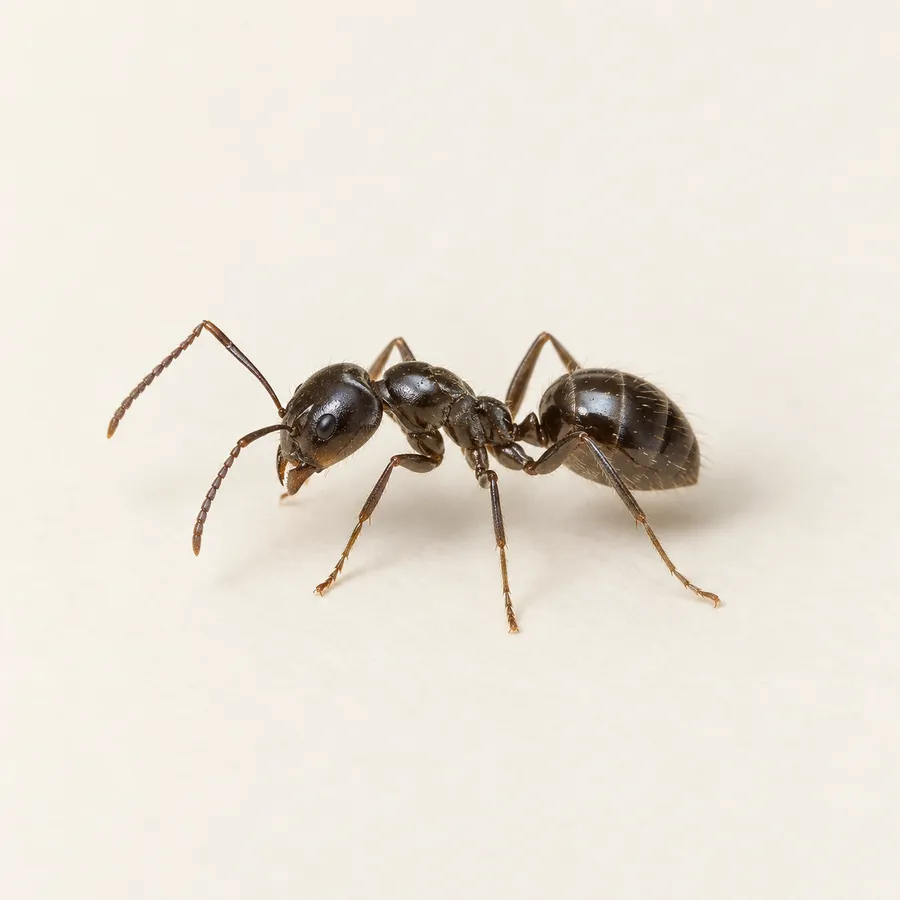
Dark brown to black, 2–4 mm, moving fast in dense trails across the counter and along the baseboards. Crush one and it gives off a sharp smell. The colony has several queens and satellite nests, so spraying splits it up. I often find its nest in balcony planters, under floor tiles and inside walls.
Pharaoh ant Monomorium pharaonis
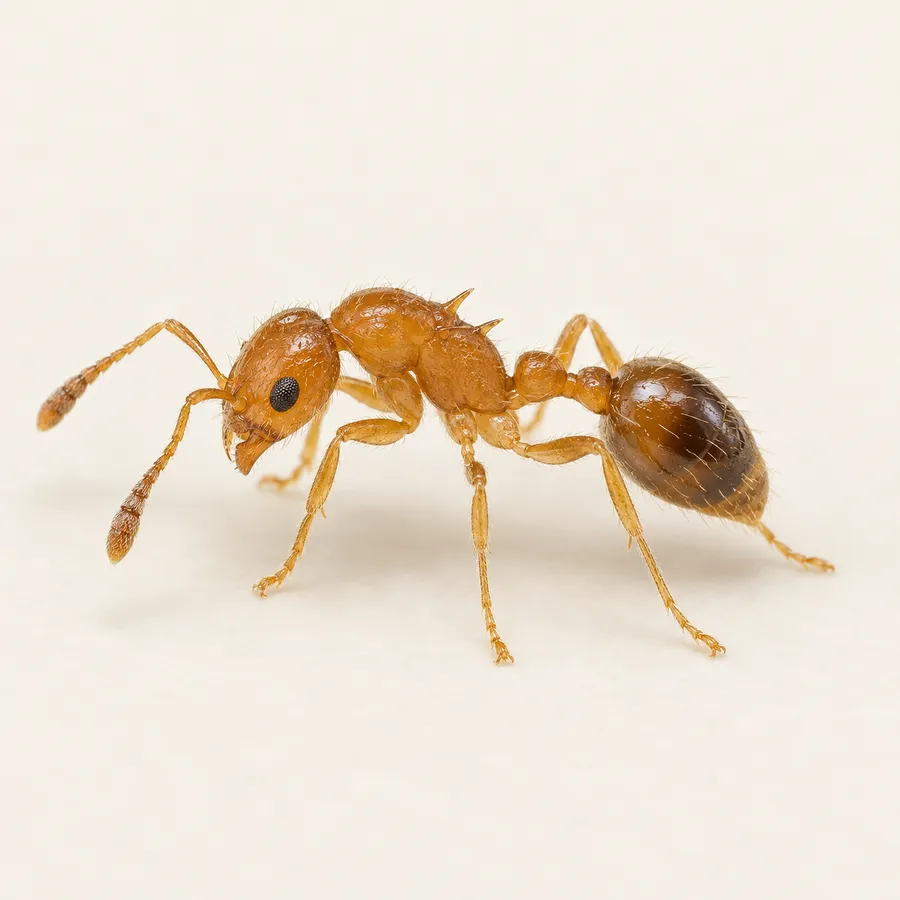
Tiny, about 2 mm, yellowish amber in color. It nests in warm voids inside the building: in walls, behind cabinets and inside appliances. It has many queens, and when it’s sprayed it splits into new nests. Against this ant, bait is almost the only way.
Harvester ant Messor spp.
Larger, usually black, and it collects seeds, not sugar. You spot it by the pile of husks and chaff around a hole in the paving stones or at the edge of the lawn. It rarely comes indoors, and at the edge of the yard it’s better left alone. I treat it when a nest under the paving makes the tiles sink.
Ants travel along edges, not in straight lines: the grout between floor tiles, the baseboard, the silicone seam between the counter and the wall, a water pipe or an electrical conduit running into a cabinet. So the trail is a map of the gaps they use to get in. Before you wipe it away, watch it for a few minutes.

- 1
Direction of travel
An ant carrying something is heading to the nest, and an empty one is leaving it. Following a few ants is enough to tell which side of the kitchen the trail leads to.
- 2
Where the trail disappears
The spot where the line vanishes into a seam, behind a cabinet or under a door frame is the entry point. It’s usually not the nest, but that’s where I start looking.
- 3
A trail that vanishes behind the sink
Usually the ants are coming in along a pipe opening, and the nest isn’t in the kitchen at all. I check the cabinet under the sink, the water and sewer pipe openings and the dishwasher connection.
- 4
Ants on balcony planters
Loose soil in a pot and ants on its sides mean the nest is inside the root ball. This is very common, especially on high floors.
- 5
A trail climbing to the shutter box
A sign of a nest in a sheltered void inside the wall or in the roller shutter box itself. This kind of infestation keeps coming back until the void is treated.
- 6
Winged insects on the windowsill
In spring or after rain, this is a mating swarm. Sometimes they’re termites and not ants at all, so keep a few of the shed wings and send me a photo.
Every ant infestation runs on three engines: the food that draws them, the trail that guides them and the nest that keeps producing new workers. Cleaning deals with the food and erases the trail for a few hours, but it doesn’t touch the nest. That’s why even a spotless kitchen gets ants.
They come for water
In a heat wave the soil dries out, and the trail leads to the sink, the drain trap, a plant saucer or the air conditioner’s drain pipe. These spots stay damp even in a perfectly clean kitchen.
Aphids in the yard feed the nest
Aphids and scale insects on a ficus hedge, a citrus tree or a bougainvillea give off sweet honeydew, and the ants guard them like a herd. As long as there are aphids, the nest gets sugar even when the kitchen is clean.
Spraying splits the colony
Some house ants have several queens and satellite nests. When a repellent is sprayed around the nest, part of the colony moves out with a queen and sets up a new nest somewhere quieter. Instead of one trail in the kitchen you get two, and sometimes the second one is in the kids’ room.
Repellents only move the trail
The workers stop crossing the sprayed line, and the ants vanish from sight. For a week or two it looks like success, then the trail comes back along a different route. The nest isn’t harmed at all.
Homemade bait kills too fast
A strong homemade mix kills the worker on the counter before she can reach the nest. And it sits at toddler and dog height, with no label and no first-aid instructions.
A worker that finds liquid food doesn’t eat it alone. She carries it in her crop and passes it mouth to mouth through the nest, to other ants, to the larvae and to the queen. I use their own trail to get the product inside.
- 1
Identify and track
I identify the type of ant, follow the trails outside the home as well, and check planters, paving, shutter boxes and air conditioner drain outlets. If I suspect the little fire ant, the treatment is completely different.
- 2
Bait that works slowly
The worker needs time to bring the bait to the nest and share it before it affects her. A product that knocks her down within minutes leaves the nest intact.
- 3
More than one type
Sometimes the colony wants sugar, and sometimes fat and protein, depending on the season and how many larvae there are. I put out several types, check what actually gets eaten, and only then expand. That’s why what worked at your neighbor’s doesn’t always work at yours.
- 4
Spots children can’t reach
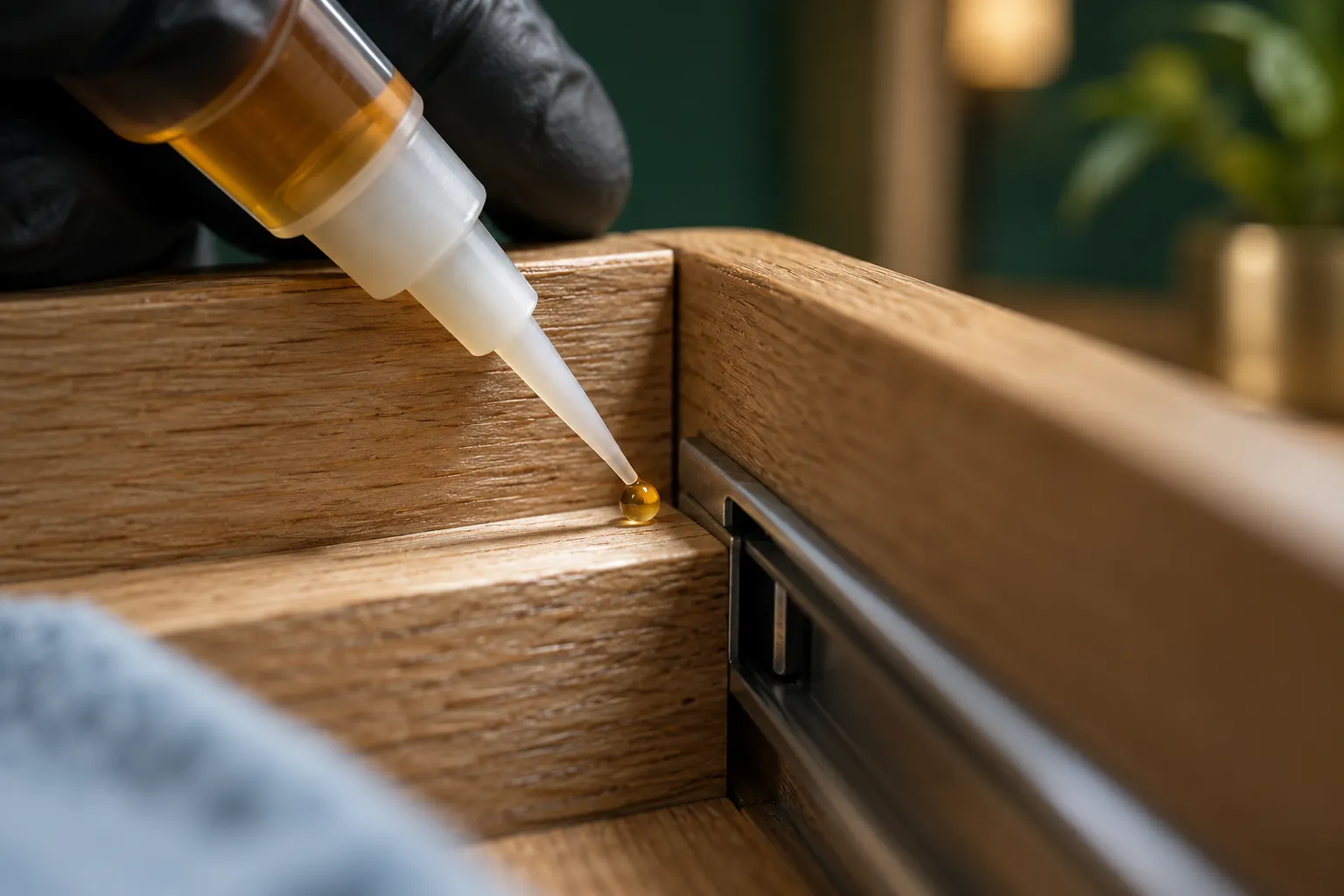
Drops of gel in drawer runners, in seams and in the corners behind appliances, plus closed stations when needed. You get a list of every spot from me.
- 5
Sealing and a follow-up check
Once the nest weakens, the gaps they came in through get sealed: peeling silicone behind the sink, pipe openings, the shutter box. If needed, I come back to check after about two weeks.
Do
- Photograph the trail and one ant up close, before you wipe anything
- Note where the trail comes in and where it disappears, at two different times of day
- Leave one trail active if you can. A live trail is my route to the nest
- Close up open food, clear crumbs from under appliances and empty water from plant saucers
- Clear access to the cabinet under the sink, the corners and the balcony planters
- Tell me if you’ve already put anything down at home, and what
- Tell me about a baby, pregnancy, asthma, a dog, a cat or an aquarium
No need
- Spraying or washing away the trail
- Blocking the trail with powder, cinnamon or a repellent
- Making a sweet mix with pesticide
- Emptying the kitchen cupboards. The bait goes into small points, not onto the shelves
- Wiping away every ant you see in the first days. Those are the workers carrying the bait to the nest
- Leaving the house. Bait treatment has no waiting time
Containers that close tightly
Sugar, honey, cereal and pet food in containers with airtight lids. A rolled-up bag with a clip won’t stop ants.
A dry sink at night
In summer, ants are looking for water. Dry the sink, don’t leave a wet sponge on the counter, and check that the air conditioner pipe isn’t dripping by the wall.
Raised planters
Lift pots off the floor onto feet, empty standing water from the saucers, and check every new plant before it goes out onto the balcony.
Dealing with aphids
A ficus hedge, citrus tree or bougainvillea with sticky leaves feeds the nest outside. Treating the aphids cuts down how many ants the yard can support.
Sealed gaps
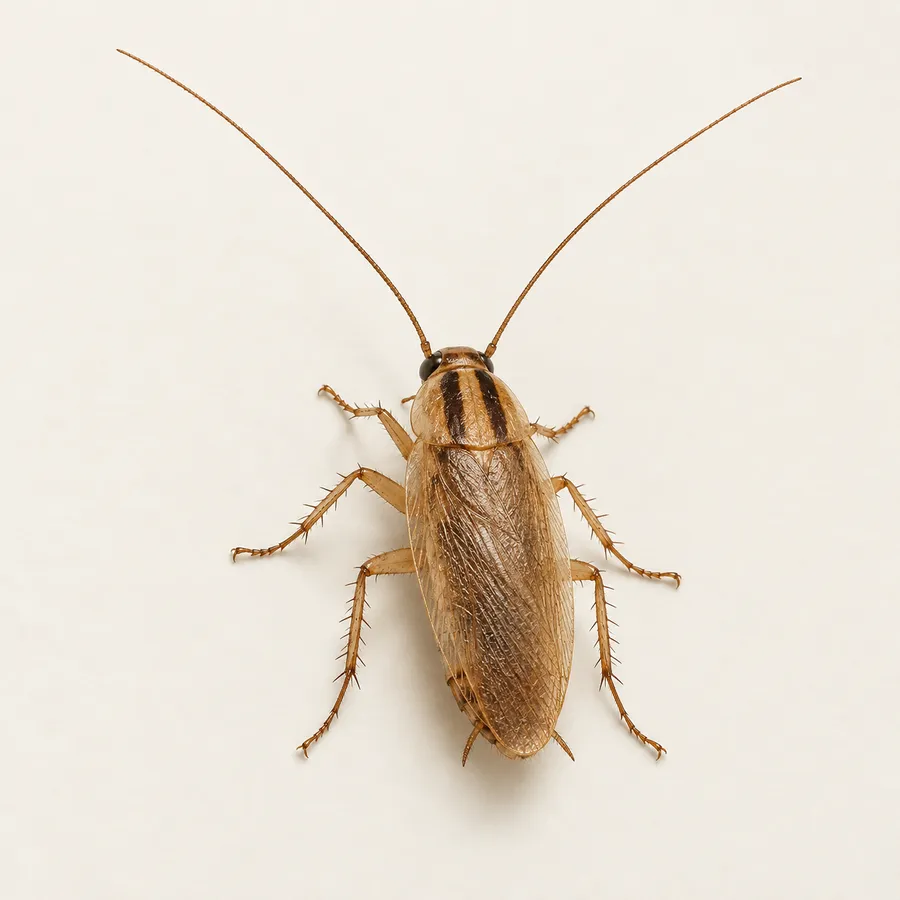
Peeling silicone behind the sink, open grout lines by the baseboard and unsealed pipe openings are the way in. Cockroaches use the same gaps, so it’s worth sealing them properly once.
Plants away from the wall
Branches touching the house wall or the balcony railing are a bridge for ants from the yard to the windows.
How long I am in the house
Ant work inside the house usually takes 30 to 60 minutes. Most of that goes on following the trails and finding the entry point, rather than on placing the bait itself. When the nest is in the yard or in the outside wall, add time for the work outdoors.
Where I actually work
Along the trail line: drawer runners, the join between the worktop and the wall, behind appliances, the window track, the air-conditioner pipe crossing and the shutter box. Outside, along the threshold, in the planters and in the paving joints. I don’t spray the kitchen.
You can stay at home
For ants I work with gel drops and closed stations, in places a toddler or a dog can’t reach. There’s no waiting time, and no need to clear the apartment.
A list of spots in hand
In a home with children or pets, I send you a WhatsApp message with where I put bait and what the instructions are. Keep the message until the follow-up check.
Ants crowding around the bait
More ants near a bait spot on the first day means they’re taking it to the nest. Don’t wipe and don’t spray, it settles down within a few days.
An ant that stings is a different story
If the kids or the dog get stung in the yard and feel a burning sensation, it’s probably the little fire ant. Tell me, because it needs a different treatment.
What not to wipe and not to wash
For the first two weeks, don’t wipe the trail line and don’t wash the corners where I placed bait. Normal cleaning of the worktop and the floor is perfectly fine, and welcome.
The price depends on the number of rooms, and in a ground-floor apartment or a house also on the yard and the number of drains. It includes identifying the ant, tracking the trails, several types of bait, sealing recommendations, a follow-up check when needed and a warranty. I tell you what it will cost in your home after I identify the ant.
| Property or treatment | Price |
|---|---|
| Apartment up to 3 rooms | ₪350 |
| Extras | |
| Each additional room | Extra₪50 |
| Ground-floor apartment or house: small perimeter and yard | Extra₪50 |
| Large perimeter and yard | Extra₪100 |
| Extra-large perimeter and yard | Extra₪150 |
| Drain or manhole treatment | Extra₪35per drain |
| Cockroaches too, on the same visit | Extra₪100 |
How it adds up: A 5-room house with a large yard: ₪350 for three rooms, ₪100 for the two extra rooms and ₪100 for the yard. Total ₪550.
What changes the price
- Where the nest is: inside the home, in planters or in the yard
- The type of ant, and whether the colony has several queens
- How many trails there are, and in how many rooms
- Whether aphids in the yard are feeding the nest
- For a food business, office or institution, I give a price after a site survey
How you know the ant treatment worked, and how you know they came back
Day one: more ants is actually good
An hour after the bait goes down you may see several times as many ants around it. That’s exactly what should happen. The workers recruit more workers, and the product reaches the nest in a quantity that also feeds the queen and the larvae.
Three to ten days: the trail thins out
In most homes the trail weakens within a few days and disappears within one to two weeks. A large nest, or one sitting in the outside wall and the yard, can take longer, and then I add a second round.
How I measure success
At the follow-up I check whether the bait at each point has been eaten, whether workers are still on the line, and whether a new trail has opened somewhere else. Untouched bait means one of two things: the nest is no longer active, or the texture doesn’t match the season. That’s why I put down more than one kind.
The check you can run yourself
Put a small spoonful of something sweet and a small spoonful of something greasy on a piece of paper, where the trail used to run, and look again two hours later. If there are no ants on either one, the nest is no longer sending workers there.
The signs that say they came back
A new trail in the same place or somewhere else; winged ants inside the house, which point to a mature nest nearby; thin heaps of soil between paving stones or in a window sill groove; and ants that turn up specifically around the air conditioner or the electrical box.
Trails that multiply after spraying
When a nest of certain species is sprayed, the colony splits into several small centres, and the result looks like things getting worse. That’s why I don’t spray a trail, and why I ask you not to spray in the weeks that follow.
What to do when a new trail appears
Don’t wipe it and don’t spray it. Photograph it and send it to me with the place and the time. There’s a warranty on the treatment. If the same nest becomes active again during the warranty period, I come and complete the treatment.
A new nest from outside
A new colony that came in from outside, for example with a plant you bought after the treatment, is a separate event. I explain the difference before we start.
When you can try it yourself
A small trail after the first rain sometimes settles down on its own within a few weeks, if the gaps are sealed and food is closed away. With ants, DIY treatment with the right bait can work, and I’ll soon have a kit with bait and instructions. If the trail is still active after two weeks, write to me.
How long until the ants are gone after treatment?
In most cases there’s a clear drop within a few days, and steady quiet within about two weeks. The pace depends on the size of the nest, its distance from the bait and the season. More activity on the first day is part of the process. If there’s still an active trail after two weeks, write to me and I’ll come and check.
Do I need to leave home during ant treatment?
Usually not. The treatment is based on bait in precise spots, not on spraying rooms. You need to clear access to the corners, the cabinet under the sink and the planters, and cover any exposed food. With ants I hardly ever spray, and if I do need to, I give you an exact waiting time before the surface can be used again.
Why are there ants in an apartment on a high floor?
The nest doesn’t have to be in the ground. On high floors it usually sits in the root ball of a balcony planter, in the shutter box, behind cladding or in an air conditioning duct. Pipe shafts and electrical conduits connect the floors, and ants travel through them without ever leaving the building.
Are ants in the house a health risk?
Most house ants don’t sting and don’t cause direct harm. They do move between the trash, the drains and food surfaces, and can carry contamination on their bodies. The exception is the little fire ant, which gives a burning sting. If someone at home has been stung, send me a photo of the ant.
I only have ants in the yard and between the paving stones. Do I need treatment?
Not always. A colony at the edge of the yard that doesn’t reach the house walls is usually a tolerable nuisance, and the harvester ant is even good for the garden. I recommend treatment when the trail reaches the wall, the openings or the pergola, when a nest under the paving makes the tiles sink, or when the ant stings.
How do I tell an ant swarm from a termite swarm?
By the body and the wings. A winged ant has a narrow waist, bent antennae and a front wing longer than the hind wing. A termite has an even body with no waist, straight antennae and four wings of equal length. Termites damage the wood in a building, so if you find wings on the windowsill, keep a few and send me a photo.
Do cinnamon, vinegar or chalk stop ants?
They can divert a trail for a few days, because they blur the chemical marker or put the ants off. The nest isn’t harmed, and the trail comes back along another route. When I come in afterwards, it’s harder to follow the trail and find the entry point. Better to photograph it and leave it where it is.
Why are there ants around the air conditioner?
The air conditioner gives them two things: a steady water supply from the drain pipe, and an easy route along the piping that runs through the wall and ceiling. I check where the drain comes out, the space above the drop ceiling and the AC ducts. Often a drain pipe dripping by the wall is enough to keep a trail going.
The ants show up in winter too. Does that mean the nest is inside the house?
Usually, yes. A surge after the first rains or during a heat wave is pressure from outside, and if the gaps are sealed it settles within weeks. A trail that keeps going in winter and in mild weather almost always points to a nest inside the walls, or to a steady food source that hasn’t been dealt with. In an apartment building, the nest can also be in a shared wall or a shaft.