In short
Most fleas in a home aren’t on the dog or cat. They live as eggs, larvae and pupae along floor edges, in rugs and in shady yard corners, so they return even after vet treatment. I treat floors, the yard and cracks where ticks lay eggs, while the vet treats the animal that same week. After 14–21 days I check whether a top-up is needed. The treatment has a warranty.
- Size
- Flea 1–3 mm · Hungry tick about 3 mm, and up to about a centimeter after a blood meal
- Movement
- Fleas jump but don’t fly. Ticks walk and climb, but don’t jump
- Where most of them are
- Eggs, larvae and pupae on the floor and in the yard. Only adults live on the animal
- Life cycle
- About 3 weeks in summer heat, two months or more in a cool room in winter
- Pupa
- Waits in its cocoon for weeks or even months, and hatches when it senses vibration, warmth and breath
- Season
- All year round indoors. Peaks in late summer and autumn
- On people
- Fleas bite us, but they don’t live or breed on our skin
- Diseases
- Fleas can pass tapeworm to dogs and cats. In Israel, the dog tick transmits spotted fever

Cat flea Ctenocephalides felis
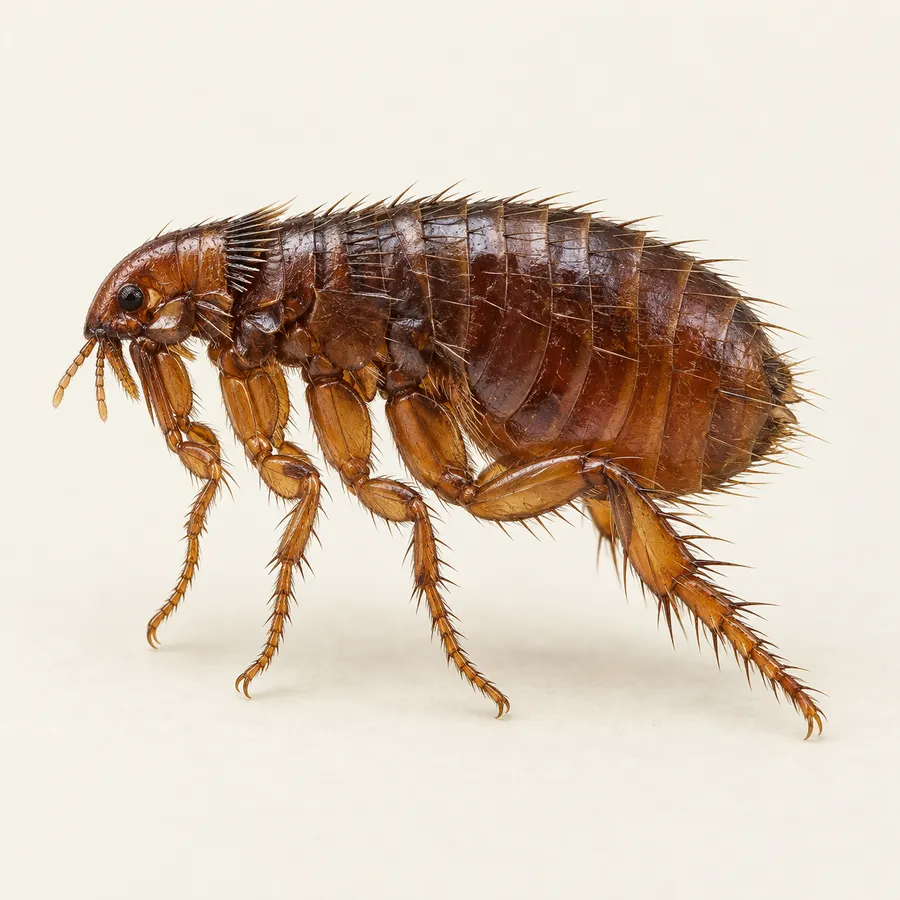
The flea I find in almost every home, even when there’s only a dog. Dark brown and flattened from side to side, so it slips between the hairs of the coat, and it jumps high for its size. The female lays dozens of eggs a day, and they drop off the coat wherever the animal rests.
Brown dog tick Rhipicephalus sanguineus
The tick I come across in homes in Israel. It’s unusual in that it completes its whole life cycle inside a building, with no field or vegetation. A female full of blood drops off the dog, climbs into a dry crack in a wall, a door frame or a shutter box, and lays thousands of eggs there.
Bites on your ankles after sitting on the rug, a dog that won’t stop scratching, a dark speck jumping onto a white sock. Before I come, I want to make sure it’s a flea and not a bed bug or a mosquito, because each one is treated differently. These are the signs I check, and you can check most of them yourself:

- 1
Bites below the knee
Small clusters of 2–3 bites on the ankles and shins, and sometimes along the waistline for anyone who sat on the floor. Some people in the household may show nothing at all, because sensitivity varies from person to person.
- 2
Black specks that turn red
Run a fine-toothed comb along the dog’s or cat’s back over a sheet of white paper, then wet a black speck that falls. A rusty-red halo spreading around it is digested blood, which means fleas.
- 3
Scratching at the base of the tail
An animal that scratches and licks its lower back and the base of its tail. Some dogs and cats are also sensitive to flea saliva, with bald patches and small sores.
- 4
The white sock test
Walk for a few minutes in white socks on the rug and in the hallway where the animal spends its time. Fleas that jump onto the fabric stand out clearly against the light background.
- 5
A tick climbing the wall
A tick on the living room wall, near a door frame or in a ceiling corner means there’s already an egg-laying site in the house. It didn’t just fall off the dog a moment ago.
- 6
Bites when you enter an empty apartment
You walk into an apartment that’s been shut up, and less than an hour later everyone is scratching. Pupae that were waiting quietly hatch together when they sense footsteps and body heat.
This is the story I hear most often: the dog got treated, the fleas vanished from its coat, and a week later the kids are scratching again. The vet treatment usually did work. It hits the adults that climb on to feed, but most of the population is on the floor.
The eggs don’t stay in the coat
A flea egg is smooth and falls off the animal within hours. The map of the infestation in your home is exactly the map of your dog’s routine: its mattress, the sofa, the hallway and the shady tiles by the door.
The larvae hide deep down
The larva shuns light and moves down to the base of the rug fibers, into the grout lines and the gap between the floor tile and the skirting. It feeds on the adults’ droppings, so spray on the coat or in the middle of the room doesn’t reach it.
The pupa is protected, and it waits
The cocoon is sticky and gathers dust, and household spray can’t get through it. The pupa hatches when it senses vibration and warmth, which is why a sudden wave of bites comes after a holiday or a move.
The yard and the car feed the house
A stray cat that gave birth under the deck, a shady corner where the dog rests, or the car trunk it rides in. A source left untreated brings fleas back into the house again and again.
Ticks live somewhere else
Fleas are a floor problem, and ticks are a problem of walls and cracks. Treatment aimed only at the floor leaves the ticks’ egg-laying sites as they are.
I build the treatment so that every flea that hatches in the coming weeks meets a treated surface. The animal, the house and the yard are treated in the same week, each by whoever is responsible for it.

- 1
Identification and questions about the home
I confirm it’s a flea or a tick, from a photo or on site, and ask about every animal in the house, and about babies, pregnancy and an aquarium. The answers decide the product and the waiting time.
- 2
Coordinating with the vet
I don’t treat the dog or cat themselves. I ask that all the animals in the house get vet treatment as close as possible to my visit, including the ones that aren’t scratching.
- 3
Mapping the resting spots
I go over the animal’s route through the house and yard: its mattress, the sofa, the hallway, the shady corner by the fence, the storeroom and the space under the deck. That’s where the larvae and pupae are.
- 4
An active layer and a growth regulator
Along the floor edges, under furniture and around rugs I apply an odorless microencapsulated product, together with a growth regulator that stops the larvae from maturing. In the yard I treat only the shady, damp spots.
- 5
Ticks: cracks up high
When there are ticks, I treat the cracks in walls, door frames, ceiling corners and shutter boxes, and point out the cracks worth filling once the treatment has worked.
- 6
A check in the hatching window
After 14–21 days, when most of the pupae have hatched, I check whether any hot spot is left and complete the treatment if needed. With a heavy infestation, this top-up is planned in advance.
Do
- Vacuum the room edges, under the furniture and the sofas thoroughly, and empty the vacuum straight into a bin outside the house
- Vacuum again on the morning I arrive, before I come in
- Wash the animal’s bedding and blankets at the highest temperature the fabric allows
- Pull sofas and beds away from the wall and clear piles off the floor, so I can reach the edges
- Book vet treatment for all the animals in the house, in the same week
- Take the mats out of the car and vacuum under them, if the dog rides with you
- Tell me in advance about a baby, pregnancy, asthma, an aquarium or a cage
No need
- Throwing out a rug, sofa or mattress. Fleas don’t nest inside furniture
- Clearing the middle of the room. What matters to me are the edges
- Using a supermarket spray before I arrive
- Setting off a fogger. It doesn’t reach the base of the rug or the grout lines
- Washing everything in the house. What needs washing is the animal’s bedding and whatever it sleeps on
- Bathing the dog in flea shampoo instead of vet treatment. Shampoo clears what is on it now and protects nothing afterwards
Ongoing vet treatment
Regular prevention for the dog and cat as your vet recommends, all year round and not only in summer. This is the first line of defense, and it costs far less than pest control.
A check after every outing
After a park, a dirt path or a boarding kennel, check the dog before it comes inside: in the ears, between the toes, in the armpits and under the collar.
Weekly vacuuming along the edges
Vacuuming the room edges and the animal’s resting spots removes eggs and droppings before they turn into a new generation.
A yard with no hiding spots
Clear piles of garden cuttings, keep plants away from the walls and close off the spaces under the deck and balcony, after making sure no animal is inside.
Feeding bowls away from the door
If you feed street cats, move the bowls well away from the entrance to your home and building. A feeding station by the door gathers fleas a meter from your doorstep.
Filling cracks after ticks
Cracks in walls, joints between blocks and gaps behind skirting boards are where the brown dog tick lays its eggs. Filling them after the treatment prevents the next generation.
How long I am in the house
In an apartment the treatment usually runs one to two hours, depending on the number of rooms and on how many rugs and sofas there are. When the yard and the dog’s outdoor resting spots are treated as well, it takes longer.
Where I actually work
Along the floor edges by every wall, under the furniture, around and beneath the rugs, at the base of the sofa and in the animal’s sleeping places. When there are ticks as well I go up into wall cracks, door frames, ceiling corners and shutter boxes.
You leave the house, and when you come back
Flea work leaves an active layer on the floor and along the edges, so you leave the house for the waiting time stated on the product label. You come back once the surfaces have dried and the rooms have been cross-ventilated. I give you the exact time before I start and send it in a message too.
Pets, aquariums and cages
The dog and the cat leave the house for the whole waiting time, along with their bowls and bedding. An aquarium gets its pump switched off and a cover on, and a bird or rodent cage goes out of the room. I ask about each of them before I open my kit bag.
Dog products are dangerous for cats
Some veterinary products for dogs are very dangerous for cats. Don’t put drops or a collar bought for a dog on a cat. A vet decides what suits each animal.
Toddlers who crawl on the floor
Flea treatment sits right at floor level. In a home with a toddler I extend the waiting time, and you come back only after the surfaces have dried and the rooms have been aired, following the instructions I send on WhatsApp.
Removing a tick from the skin
With tweezers, close to the skin, in a slow, steady pull, without twisting or squeezing. No fire, oil or alcohol on the tick. Fever or a rash in the weeks that follow means you need to see a doctor.
Don’t wash the edges
Vacuuming is allowed and even helps. Washing the floor too early strips the active layer from the edges, and I tell you at the end of the treatment when it’s fine to wash.
Vacuuming afterwards is part of the treatment
From the next day on I ask you to vacuum the edges and the rugs every day or two, for two to three weeks. The vibration and warmth of the vacuum draw the pupae out of their cocoons and onto the active layer. Empty the bag into a bin outside the house each time.
The price is based on the size of the area that needs treatment, in square meters. It includes treating the house and yard according to what I found, and a follow-up visit when needed. You hear from me what it will cost in your home once I’ve identified the problem.
| Property or treatment | Price |
|---|---|
| Area up to 80 m² | ₪450 |
| Area up to 120 m² | ₪600 |
| Extras | |
| Each additional 100 m² | Extra₪350 |
How it adds up: A 220 m² house: ₪600 for the first 120 m² and ₪350 for the additional 100 m². Total: ₪950.
What changes the price
- Fleas only, or ticks too, which need treatment in cracks and walls
- The size of the yard and the number of shady corners where the animal rests
- How many rooms have rugs or carpets
How you know the flea treatment worked, and how you know they came back
The first two weeks: you still see fleas
The pupal cocoon is sealed, and no product penetrates it. The flea inside comes out when it senses vibration, warmth or carbon dioxide, and then it lands on the active layer. That’s why single fleas still turn up in the first two weeks, and it’s part of the process.
The white sock test
Walk along the edges of the room in white socks for a minute or two, then look at them. A flea jumps towards whatever moves and is warm, and on a white sock you see it straight away. Do it once a week, in the same rooms, so you have something to compare.
The water dish at night
A shallow dish of water with a drop of washing-up liquid, on the floor of the suspect room, under a night light left on. Fleas jump towards the light and get caught in the water. Three nights in a row with no flea in the dish is a good sign.
The check on the animal
Comb the dog or cat with a fine flea comb over damp white paper, especially at the base of the tail and around the neck. Flea dirt is digested blood, and it smears reddish-brown on damp paper. If no specks smear red, there’s no active feeding.
The signs that say they came back
Fresh bites on ankles and shins, in groups of two or three; an animal scratching or biting at the base of its tail; new flea dirt on its bedding; and fleas jumping on you the moment you walk into a room that has been shut for a few days.
A flea after three weeks
At that stage it’s no longer pupae from the original infestation. Photograph it, check when the last vet treatment was, and send it to me. There’s a warranty on the treatment. If the fleas come back to the same home during the warranty period, I come back to check and treat. I explain the terms before I start.
The animal is part of the plan
The warranty relies on every animal in the house being treated by the vet. An untreated dog will bring fleas back to any home, even after a precise treatment.
A new source is a new event
A cat that gives birth under the deck again, or a dog back from a kennel with fleas, is a new infestation. I tell you this up front.
What you can do yourself
Daily vacuuming, hot washing of the animal’s bedding and vet treatment help a lot, and are sometimes enough for a light infestation caught early. When the bites go on for more than two weeks, or there are ticks on the walls, a supermarket spray won’t reach the places where the population lives.
Can fleas live on people?
No. A flea will bite people when there’s no dog or cat nearby, but it doesn’t stay on the skin or breed on us, because our hair is too sparse for it. So bites on people in the household mean there’s a population on the floor and in the yard. There’s no need to put any anti-flea product on your body.
We don’t have a dog or cat. Where did the fleas come from?
In most cases, from pupae left waiting in the apartment since the previous tenants, from street cats nesting in the yard, the storeroom or under the deck, or from a pigeon nest in the shutter box. A pupa waits in its cocoon for weeks or even months and hatches the moment it senses footsteps and warmth. I look for that source, because without it the treatment won’t hold.
Do I need to throw out the rug or sofa because of fleas?
Almost never. Unlike bed bugs, fleas don’t nest inside furniture, but at the base of the fibers and along the edges. Thorough vacuuming, washing the animal’s bedding and treating the floor edges solve most cases. Dragging an infested rug outside mostly scatters eggs along the way.
How long do fleas survive in an empty apartment?
An adult flea with no host survives days to weeks. Pupae last much longer, weeks and sometimes months, inside a cocoon that protects them. That’s why an apartment left empty between tenants can attack whoever walks in within the first hour. If you’re moving into an apartment like that, it’s worth treating it before the furniture goes in.
Do fleas move between apartments in a shared building?
Not on their own. A flea almost always travels on a host: a cat that gets into the stairwell, a dog walking down the hallway, or items passing through a shared storeroom. When there are bites in several apartments, I check the stairwell, the storerooms and the parking garage too, not just the apartment that called me.
Is there a link between fleas and worms in dogs?
Yes. A flea can carry tapeworm, and dogs and cats get infected when they swallow a flea while licking and scratching. That’s one more reason to treat the house and the animal at the same time. Diagnosing and treating worms is the vet’s field, and I just remind you to ask about it.
Do fleas disappear in winter?
No. Outdoors they slow down, but inside an Israeli home the temperature stays in a range that suits them almost all year, and the cycle carries on even in January. The peak is in late summer and autumn, so an infestation left untreated in August drags on indoors into the winter.
I’m still seeing fleas a few days after treatment. Is that normal?
Yes, up to a point. In the first few hours activity even rises, because the treatment and the vibration drive adults out of hiding. Over the next two weeks pupae keep hatching and land on a treated surface, so a single bite every few days is to be expected. If activity doesn’t die down after 14–21 days, I come back to complete the treatment.
I found a tick on my child. What should I do?
Remove it right away with tweezers, close to the skin, in a steady pull, without twisting or squeezing. Disinfect the spot and keep an eye on it. Fever, a rash or feeling unwell in the days and weeks that follow means you should see a doctor, because in Israel the dog tick transmits spotted fever. If you’ve also found ticks on the walls, the house needs treatment.