In short
The little fire ant is an invasive ant about 1.5 mm long, with a burning sting. Colonies have dozens of queens in scattered nests, so spraying only hits ants outside, and they’re back within weeks. I map the nests and spread slow-acting bait that workers carry inside, in two rounds. A balcony or enclosed yard can be fully cleared. In an open garden, the goal is a yard you can sit and play in.
- Size
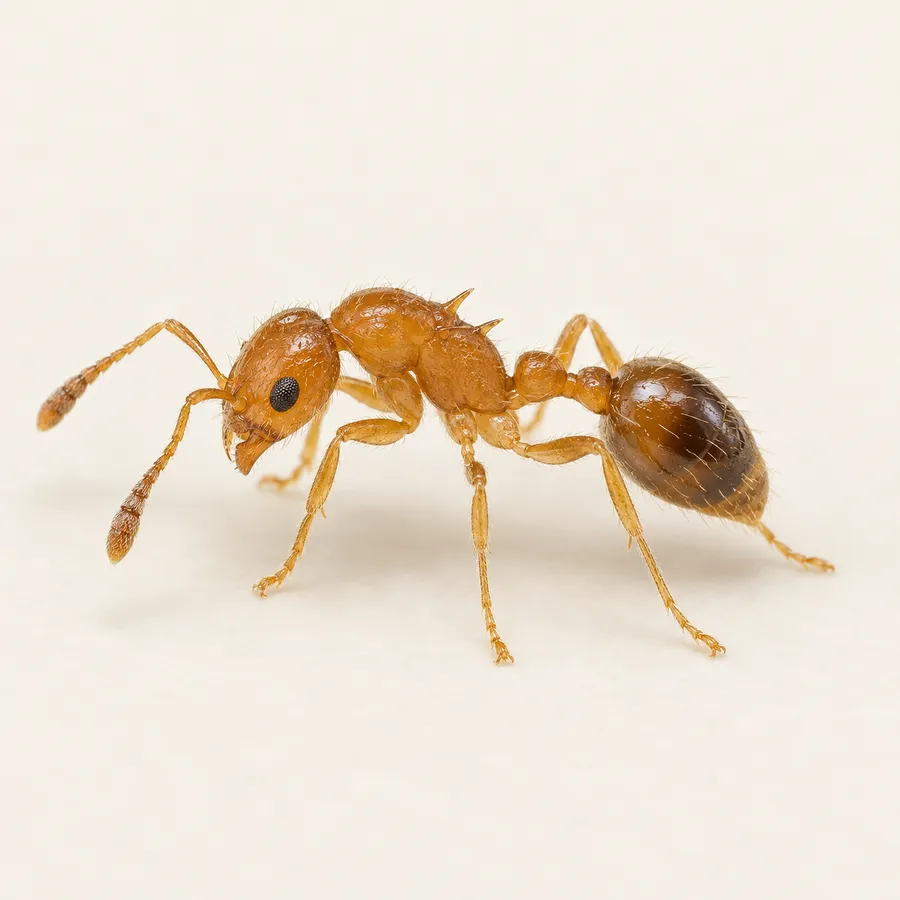
- About 1.5 mm, and all the workers are the same size
- Color
- Light, even golden brown
- Movement
- Slow. It doesn’t scatter in panic when disturbed
- Colony
- Dozens of queens in scattered nests that don’t fight each other
- Where
- On the ground, on trunks and leaves, and in palm crowns
- Sting
- An instant burning, then a red bump that itches for several days
- Main food
- Honeydew from aphids and scale insects on plants
- Winter
- Activity almost stops, and the colony survives under the paving
Most people feel it before they see it. You kneel to weed a flower bed, your child sits down on the lawn, you take the washing off the line, and a few seconds later there’s a sharp burning on the back of your neck or your ankle. You look down and find nothing, because the worker is too small to see at a quick glance. These are the signs that set it apart from a local garden ant.

- 1
Tiny and uniform
About 1.5 mm, light golden brown, and every ant on the trail is the same size. A local garden ant is usually bigger and darker, and its trail sometimes has ants of two sizes.
- 2
Slow and unbothered
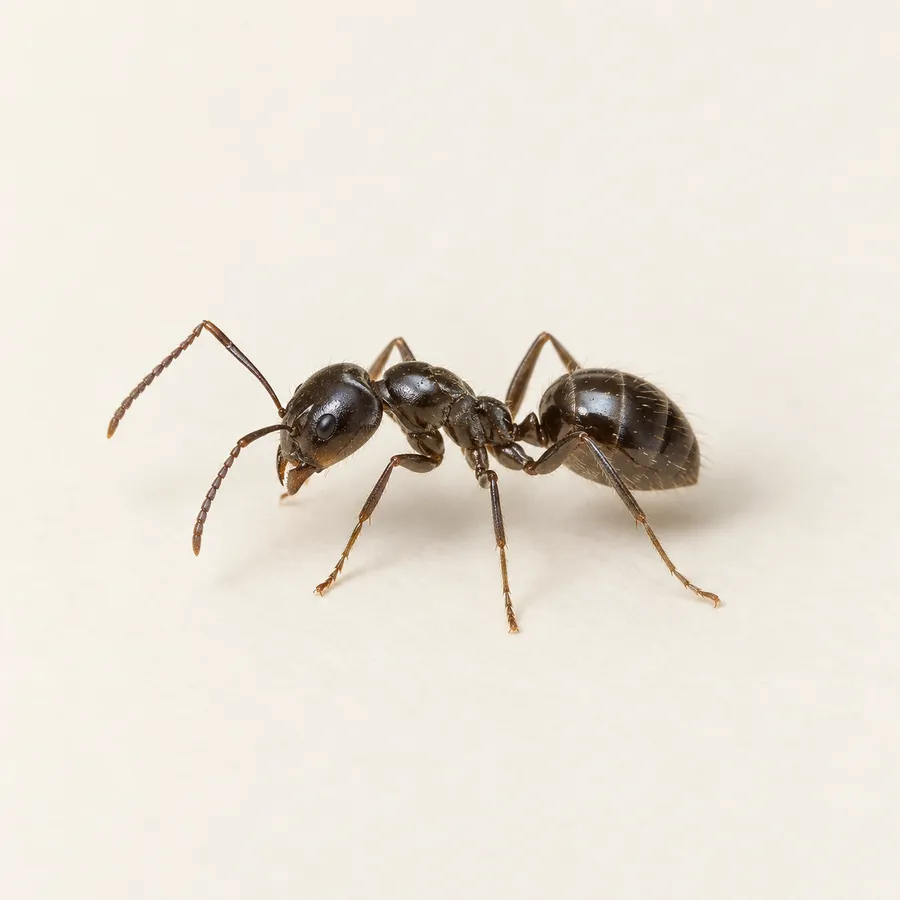
When you disturb its trail, it keeps moving slowly, almost indifferently. An ordinary black ant scatters instantly in every direction.
- 3
Stings on the shoulders and neck
It also lives on tree trunks, among leaves and in palm crowns. A sting on the shoulder while pruning or standing under a tree is typical of it, and not of ants that only walk on the ground.
- 4
Stings from inside your clothes
It hardly ever attacks on its own initiative. Most stings happen when it gets trapped between skin and clothing: under the elastic of your pants, in the collar of a shirt that dried outdoors, in a gardening glove left on the flower bed.
- 5
Sticky leaves and black sooty mold
On a citrus tree, a ficus or a dense shrub. That’s honeydew from scale insects, and the ants farm them and guard them from their natural enemies.
- 6
A dog or cat with a watery eye
Corneal damage and clouding of the eye have been reported in dogs and cats living in an infested yard. A watery, cloudy or squinting eye is a reason to see the vet right away.
A local ant usually has one queen and one nest. The little fire ant multiplies by splitting: a queen and a few workers walk a few meters to the side and set up another nest, which stays part of the same colony. Twenty nests in a yard are really one big unit, and that’s what defeats most treatments.
Spraying only hits the ones outside
At any given moment only a small part of the colony is out foraging. The queens, the brood and the workers tending it are in the nests. After spraying you see a sharp drop within hours, and a full comeback within weeks.
Repellents scatter the nests
A repellent product makes nests move and split. Instead of one hot spot you get several, and some of them are already in the neighbors’ yard.
Spraying kills the competition
Local ants compete with the invasive species and keep it in check. Broad spraying harms them and clears space for it.
A dead ant can’t carry bait
Spraying the day before bait goes down cancels it out and delays the treatment by weeks. That’s why I first ask what has already been sprayed in the yard.
Your fence doesn’t stop it
One colony can stretch across three yards and the public land between them. A plant pot, a sack of soil or garden furniture moving from yard to yard can carry a queen and start a new hot spot.
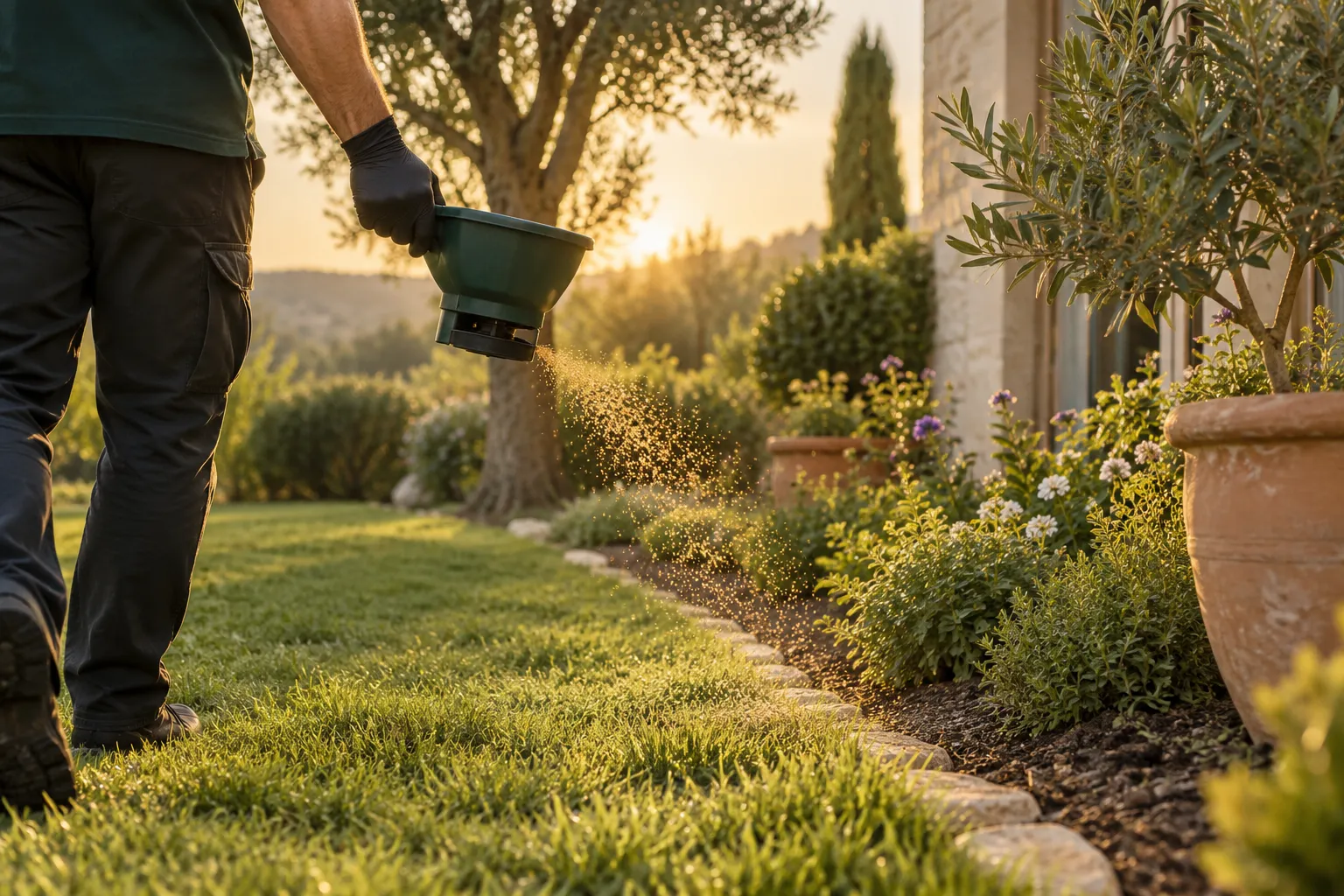
Bait is food with a low concentration of a slow-acting ingredient. The worker eats, goes back to the nest and feeds other workers, the brood and the queens. A product that kills it quickly leaves the nest intact. This is how I work, step by step.
- 1
Mapping
I identify the species and mark trails and hot spots: under pots and in their saucers, in bark mulch and piles of cuttings, under paving stones, in the cavities of block retaining walls, in irrigation valve boxes and in palm crowns. Knowing where and when you were stung helps me a lot.
- 2
Bait to suit the season
I choose the bait type by what the colony is looking for at that time of year, oily and protein-rich or sweet. In some cases I use a bait with a growth regulator, which stops the queens from producing viable brood, so the colony wears down from within.
- 3
Spread widely, not in spots
A scattered colony needs many points of contact. I spread bait granules along the active trails, in the shade and away from the drip-irrigation spray, and set closed stations along the fence and up high when needed.
- 4
Pausing the irrigation
Water breaks bait down within hours. I tell you exactly how long to turn off the irrigation in the treated areas, and when to turn it back on.
- 5
A second round after about two weeks
In the first two weeks activity drops gradually, and sometimes there’s even an increase around the bait. In the second round I renew the bait and treat the remaining hot spots and the edges of the plot.
- 6
Inside the house
When the ants come in through window tracks, pipe openings and air-conditioner passages, I treat the entry points too. The source stays outside, and without treating the yard the house will keep getting ants.
Do
- Take close-up photos of the ants, or collect a few in a closed container, and note where and when you were stung
- Note which hours of the day have the heaviest traffic on the trails
- Stop moving pots, soil, mulch and cuttings out of the infested area
- Switch off the sprinklers in the infested area the day before, and leave them off until I say otherwise
- Ask the neighbors next door if they’re getting stung too, so we can coordinate treatment in the same week
- Tell me about children, a dog, a cat, a vegetable patch or an aquarium, and what has already been sprayed in the yard
- Clear access to the fence, the retaining walls and the irrigation boxes
No need
- Spraying or digging in the flower beds before I arrive
- Putting down store-bought bait at the same time
- Pouring boiling water on the nest. It kills workers on the surface and never reaches the queens
- Clearing every piece of furniture and every pot out of the yard. I need to see where they travel
- Leaving the house. In most cases it’s enough to keep children and animals away from the treated area
Check every new pot
Lift it and look at the bottom and the saucer before it goes into the bed. It’s best to leave new seedlings on a hard surface for about two weeks, away from the garden.
Soil, compost and mulch
Deliveries of garden soil, compost and mulch spread the fire ant as much as seedlings do. Ask the supplier where the material came from.
Deal with sap-sucking insects
Aphids, scale insects and mealybugs on citrus, ficus and the shrubs along the edge of the plot feed the colony. The fewer there are, the fewer queens your yard can support.
Branches away from the walls
Plants touching the house wall or the neighbor’s fence are a bridge. Pruning them back closes off a route.
Thin mulch near seating areas
A thick layer of bark mulch right against the walls and the beds next to the lawn holds moisture and shelter exactly where you sit.
No standing water
Fix drip-line leaks, empty plant saucers, and check where the air-conditioner condensation drips.
No piles on the ground
Cuttings, bricks and bags of potting mix left on the soil for months are a permanent address for a nest.
How long I am in the yard
An ordinary yard usually takes one to two hours. Most of that is mapping: where the trails run, where the centres sit and where they come in. Spreading the bait itself is relatively quick.
Where I actually work
On the active trails: under pots and in their saucers, in bark mulch, in cutting piles, along the fence and the retaining walls, in the irrigation boxes and in the paving joints. When they come indoors as well, I treat the entry points too.
The irrigation stays off
Water breaks down granular bait within hours. I tell you exactly how long to hold the sprinklers off in the treated areas and when you can water again, and that is the main condition for the treatment to work.
Keeping away from the treated area
Children and animals stay away from the treated areas until the end of the waiting time, which is set by the product label. I send it to you on WhatsApp, along with when to turn the irrigation back on.
Distance from the vegetable patch
I mark for you where I spread the bait, and keep away from the vegetable patch, the barbecue area and the sandbox. Closed stations along the fence stand where the dog can’t reach them.
When to see a doctor
Swelling that spreads beyond the sting, a rash all over the body, dizziness or difficulty breathing are reasons to get medical help right away, even for someone who has never been allergic. If a toddler has been stung in several places, it’s worth consulting a doctor even without an unusual reaction.
Dogs’ and cats’ eyes
A watery, cloudy or squinting eye in a dog or cat that roams an infested yard calls for an urgent visit to the vet. It doesn’t wait until the garden treatment is over.
Public land next to your home
A public garden or municipal lot bordering your yard isn’t your responsibility. There, the request goes to the local authority, and I can tell you what to ask for.
In most homes the fire ant is both in the yard and inside the house, so the two are usually treated together: the yard price by its size, plus ₪150 for the house. The price includes mapping, two rounds of bait, closed stations along the fence when needed and a warranty. You hear from me what it will cost in your home once I’ve identified the ant.
| Property or treatment | Price |
|---|---|
| Yard up to 100 m² | ₪450 |
| Inside the house only, up to 3 rooms | ₪450 |
| Extras | |
| Each additional 50 m² of yard | Extra₪100 |
| House together with the yard, up to 3 rooms Most common | Extra₪150 |
| Each additional room in the house | Extra₪30 |
How it adds up: A 4-room house with a 150 m² yard: ₪450 for the first 100 m², ₪100 for the additional 50 m², ₪150 for the house and ₪30 for the fourth room. Total: ₪730.
What changes the price
- How many nests and hot spots there are, and whether the ants have already got into the house
- What borders the plot: a neighbor’s garden, a citrus grove, a wadi or a neglected lot
- Sap-sucking insects on the trees and shrubs that feed the colony
- Seasonal maintenance before the peak of the heat, in an open garden
- For a kindergarten, an institution or a business site, I give a price after an on-site survey
How you know the fire ant treatment worked, and how you know they came back
The first week: sometimes it looks like more
In the first days you may see brisk traffic around the bait points, because the workers are collecting the granules and carrying them in. That’s the sign the bait is being taken, not that things got worse.
Two to six weeks: the stings go down
The little fire ant is a colony with many queens and scattered centres, so it drops in steps rather than all at once. The measure I ask you to count is the number of stings per week, in the same areas of the yard.
The bait test you can run yourself
Put a piece of greasy sausage or an oily crisp on a square of cardboard, in the shade, at four fixed points in the yard, and count the ants after an hour. Compare the numbers at the same points at the same time of day, before the treatment and after.
How I measure at the second round
At the round about two weeks later I check which trails are still active and whether the previous spread has been eaten. A trail that has vanished and empty test cards are the sign that the centre has weakened.
The signs that say they came back
Stings returning in the same part of the yard; a dense column on a tree trunk, an irrigation pipe or a retaining wall; ants pouring out when you lift a pot; and a dog or cat that starts blinking or tearing up again.
What to do when you see a new column
Don’t spray and don’t hose it down. Photograph it, mark the spot, and send it to me. There’s a warranty on the treatment. If the ants return to the area I treated during the warranty period, I come back.
The goal is clear from the start
Before I start, you know whether the goal in your yard is full elimination or long-term control, and what the warranty covers either way.
A new infestation from outside
A colony that arrives with new seedlings, soil or mulch after the treatment is a new event. That’s why I ask you to let me know about any delivery like that to the garden.
Store-bought bait
You can buy bait and spread it yourself, but in open areas it fails in most cases. The type doesn’t match what the colony is looking for that season, it goes down in spots when it needs to be spread widely, and irrigation or spraying at the same time cancels it out. And bait left where a child or a dog can reach it is a risk in itself.
Is the little fire ant dangerous for children?
The sting is very painful, but in most cases it isn’t dangerous and passes within a few days. The risk lies mainly in multiple stings on a toddler who crawled or sat on an infested area, and in an allergic reaction. If you see spreading swelling, dizziness or difficulty breathing, get medical help right away.
Do fire ants come into the house too?
Yes. Their base is outside, in the soil, pots and plants, but they wander indoors through window tracks, pipe openings and air-conditioner passages, especially during heat waves and after irrigation. Treating only indoors deals with the ants that got in, while the colony outside stays intact.
My neighbor won’t treat. Is there any point in treating only my yard?
There is, with adjusted expectations. You can bring the numbers in your yard down until it’s usable again, and keep a treated strip along the shared fence with maintenance rounds. Without treatment next door this is ongoing control, not a one-time fix, and I say so when I give you the price.
Does winter kill the fire ant?
No. When it’s cold, activity above ground almost stops and the ants seem to have vanished. The colony survives in warm pockets: under paving, by south-facing walls, in piles of mulch and near air conditioners. In spring it comes back fast, so a quiet winter doesn’t mean the treatment worked.
When can we go back on the lawn after fire ant treatment?
The waiting time is set by the product label and the application method, and I send it to you on WhatsApp along with when to turn the irrigation back on. Until then, the children and the dog stay out of the treated areas. There’s no need to leave the house itself.
Can you get rid of fire ants completely?
It depends on the boundaries. On a sun balcony, a group of pots or an inner courtyard with no adjoining gardens, full elimination is a realistic goal. In an open garden next to a neighbor, a citrus grove, a wadi or a neglected lot, the goal is a yard without routine stings. Anyone who promises permanent elimination in open ground is ignoring the way this ant spreads.
What should I do right after a fire ant sting?
Wash with soap and water, apply a cold compress and try not to scratch. Ask a pharmacist or a doctor about a cream or anti-itch medicine. Watch for spreading swelling, a rash all over the body or difficulty breathing, because then you get medical help right away. And note where and when you were stung, since that helps me map the nests.
Why is the fire ant in our garden of all places?
It loves exactly what we build in our yards: drip-irrigated gardens, bark mulch, beds with block retaining walls and sun balconies full of pots. It usually arrives with a seedling, a pot, soil or mulch, or moves over from a neighboring yard. When there are lots of sap-sucking insects on the plants, it settles in faster.
Is fire ant bait dangerous for my dog?
Bait is a pest control product, even when the amount is tiny. That’s why I spread the amount the label specifies, in places I mark for you, and set closed stations along the fence where the dog can’t reach them. Tell me if your dog likes to dig or eat things off the ground, and I’ll adjust the placement and how long it needs to stay away.