In short
Most mosquitoes biting you in the yard hatched nearby, in standing water at yours or a neighbor’s: a plant saucer, a bucket, a clogged gutter, a manhole or an elevator pit. The Asian tiger mosquito also bites by day and lays eggs in small containers. In yards with dense greenery, I mist-spray the shady plants where adults rest and show you which water to dry up, so the bites drop over the season.
- Size
- 3–6 mm. Only the female bites, because she needs blood to produce eggs
- Asian tiger mosquito
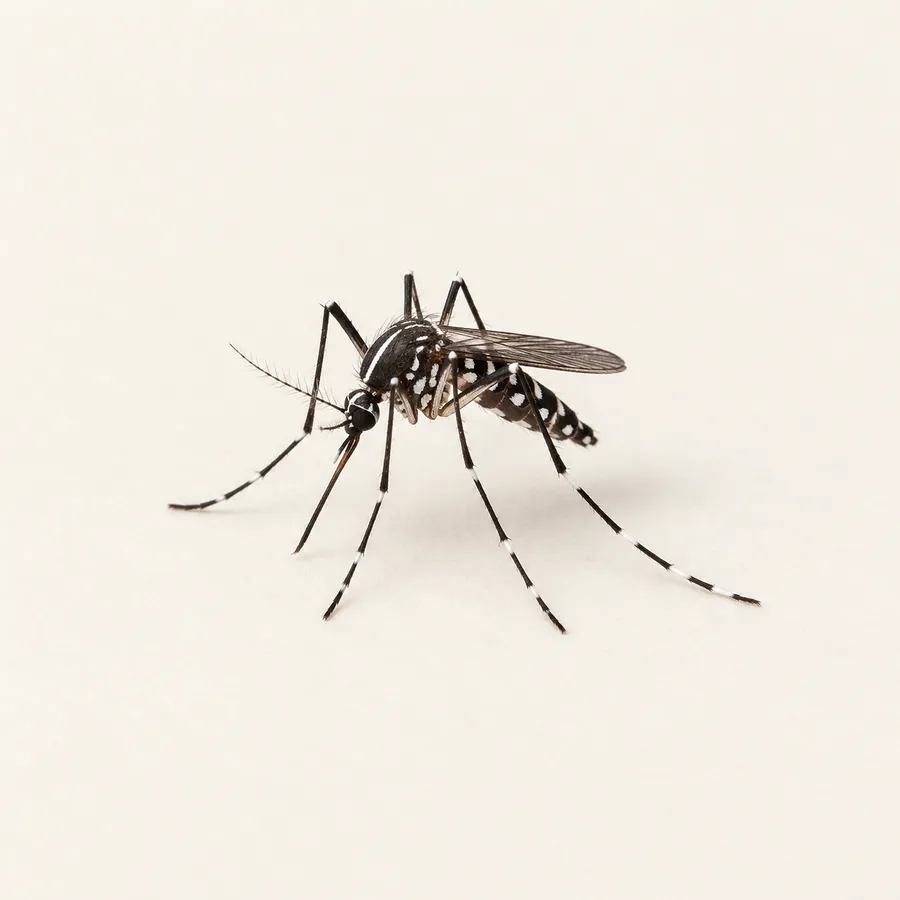
- Black with white stripes. Bites by day, mostly in the morning and afternoon, and low down, on the legs
- House mosquito
- Grayish brown. Bites in the evening and at night, and buzzes by your ear in the bedroom
- Life cycle
- From standing water to adult mosquito in about a week to ten days in summer heat
- Eggs
- Asian tiger mosquito eggs stick to the side of a container and survive months of dryness
- Flight range
- The Asian tiger mosquito usually stays within about 200 meters of where it hatched
- Season
- Mainly from spring to late fall. In basements and manholes, in winter too
- Disease
- The house mosquito is the main carrier of West Nile fever in Israel
Asian tiger mosquito Aedes albopictus
Black with white stripes on its legs and a white stripe down its back. It bites by day, persistently, and mostly on the legs. The female lays eggs on the sides of small containers holding a little water: a plant saucer, a bucket, a toy, an upturned lid or a clogged gutter. Worldwide it’s known as a carrier of viruses such as dengue, which is why Israel monitors it.

Common house mosquito Culex pipiens
Grayish brown, active in the evening and at night, and it’s the one buzzing in your bedroom. It breeds in larger and sometimes polluted standing water: sewer manholes, pits, flooded basements, a neglected pool and an elevator pit with water in it.
My first question is when you get bitten. Bites during the day, on the legs, in the garden are almost always the Asian tiger mosquito. Buzzing at night in the bedroom is the house mosquito. Then I look for the water. These are the places where I find larvae most often:

- 1
Plant saucers
Water left in the saucer under a pot after watering. A tiny amount, about a spoonful, is enough to raise dozens of larvae.
- 2
Gutters and flat roofs
A gutter clogged with leaves, a puddle that never dries on a flat roof or a balcony that doesn’t drain. Water that stands for more than a week is already a breeding site.
- 3
Forgotten containers in the yard
A bucket, a tire, a grill cover, a child’s toy, a birdbath, or a plastic sheet covering a woodpile. Anything that collects water after watering.
- 4
Manholes and drains in the yard
An inspection manhole with a cover that doesn’t seal, a floor drain in the yard or a drainage channel with a grate. This water mainly breeds house mosquitoes.
- 5
In buildings: basement and elevator pit
Water that collects at the bottom of the elevator pit, in an underground parking garage or in the pump room breeds mosquitoes almost all year round, even in winter.
- 6
Larvae wriggling in the water
Look closely at a saucer or a bucket. Mosquito larvae look like thin worms hanging just below the surface that dive to the bottom when you move the container.
People spray the yard before dinner, and the next day the mosquitoes are back, because most of the population is still in the water. These are the reasons I see in every yard:
Fogging only kills what’s flying
Spray in the air hits the mosquitoes that happen to be in it at that moment. The larvae at the bottom of the plant saucer become adult mosquitoes within days, and the yard fills up again.
The eggs wait out the dry spell
Asian tiger mosquito eggs stick to the side of the container above the waterline and survive for months. Emptying the saucer isn’t enough, you also have to scrub the sides.
The source is at the neighbors’
The Asian tiger mosquito doesn’t fly far, but a fence won’t stop it. A neglected pool or a pile of containers in the yard next door will keep sending mosquitoes into yours.
Bracelets and ultrasonic devices
Ultrasonic devices, bracelets and scented candles haven’t been proven to work against bites. A repellent you put on your skin does work, but it protects you, it doesn’t treat the yard.
I treat mosquitoes in yards surrounded by dense greenery. I spray the plants where they rest with a mist blower, and I show you how to dry up the standing water they hatch from. This is the order I work in:

- 1
Scanning for water sources
I go over the yard, the gutters and the manholes, and mark every spot that holds water for more than a few days.
- 2
Draining and removing
Whatever can be emptied gets tipped out or thrown away. I show you which containers to scrub, which gutter to clear, and which pots are worth having their saucers filled with sand.
- 3
Mist-blower spraying where they rest
By day, adult mosquitoes rest in shade and humidity: inside shrubs, in hedges, under the deck and in shady corners. The mist blower drives the product deep into dense greenery. I don’t spray flowering plants, so as not to harm bees.
- 4
A plan for the season
At the height of summer the population grows, and sometimes a repeat treatment is needed. I tell you in advance whether your yard needs one visit or several, and why.
- 5
What belongs to the municipality
If the source is on public land, such as a ditch, a street sewer manhole or a public garden, I tell you exactly what to report to the municipal hotline.
Do
- Don’t run the sprinklers on the day of treatment, or until the time I give you afterwards
- Count how many bites you get in the evening, on three evenings before the treatment. That’s the baseline we compare against
- Turn over or empty anything that holds water: plant saucers, buckets, lids, tyres and children’s boats
- Clear toys, cushions and pet bowls out of the yard
- Bring the dog and cat inside until the spray has dried
- Give me access to the whole yard, including the paths behind the house
- Tell me about any beehive nearby, a fish pond or a swimming pool
No need
- Spraying the yard the day before
- Cutting back all the plants. I need to see where the mosquitoes rest
- Pouring oil or bleach into standing water
- Hanging electric mosquito zappers in the yard. They mostly catch other insects
- Spraying body repellent onto the plants. It doesn’t replace treating the resting sites
- Clearing the house. The work is in the yard, and you only go indoors for the drying time
Empty and scrub once a week
Everything in the yard that collects water gets emptied once a week, and the sides scrubbed to remove eggs. That way the larvae don’t have time to turn into mosquitoes.
Sand in the plant saucers
A saucer filled with sand keeps the plant moist, but doesn’t hold open water that mosquitoes can lay eggs in.
Clear gutters
Clear the leaves out of the gutters before and after winter, and check that there’s no standing puddle on the roof or the balcony.
Screens and a fan
Intact screens on the bedroom windows, and a fan on the balcony. Mosquitoes are weak fliers, and a stream of air makes it hard for them to land.
Closed manholes and pits
A tight cover on the inspection manhole, the rainwater pit and the water tank. When it can’t be sealed, a fine mesh over the opening.
Repellent on the skin
During biting hours, an approved repellent with DEET or icaridin, used according to the instructions on the package. For young children, follow the manufacturer’s and your doctor’s instructions.
A cleanup day with the neighbors
In an apartment building or a crowded street, a day when everyone empties containers and clears gutters brings the mosquitoes down for all the neighbors at once.
How long I am in the yard
An ordinary yard usually takes one to two hours. Most of it is scanning for water sources and mapping the resting sites. The mist-blower application itself is quick.
Where I actually work
In the dense, shaded planting where mosquitoes rest during the day: inside the shrubs, in the hedge, under the deck, in the damp corners and along the fence. And in parallel in the gutters, the drainage chambers and anything that holds water.
You leave the yard, not the house
While I work, you and the pets stay indoors, with the windows shut on the side I’m working on. Once the foliage has dried you go back into the yard, and I give you the exact time based on the product and the weather.
Wait for the spray to dry
Children and dogs stay out of the areas I sprayed until the plants are dry. I send you the exact time on WhatsApp, based on the product.
Sprinkler irrigation
Sprinklers wash the product off the leaves and cut the treatment short. I tell you when sprinkler irrigation can resume, and drip irrigation is usually fine as normal.
Bees and flowers
I don’t spray flowering plants, and I don’t spray at times when bees are active on them. If there’s a beehive in the neighborhood, tell me in advance.
Pools and fish ponds
A swimming pool is covered while I work. I don’t spray near an ornamental pond with fish.
Fever after bites in summer
West Nile fever usually starts like the flu: fever, headache and weakness. For older adults and anyone with underlying health conditions, a fever like that in summer means seeing a doctor.
I treat mosquitoes in yards surrounded by dense greenery, because that’s where they rest during the day. I spray the plants with a mist blower, and the price depends on the size of the yard. I tell you what it will cost for your yard once I’ve seen it, in a photo or in person.
| Property or treatment | Price |
|---|---|
| Yard up to 200 m² | ₪600 |
| Extras | |
| Each additional 100 m² | Extra₪200 |
How it adds up: A 300 m² yard: ₪600 for the first 200 square meters and ₪200 for the additional 100 square meters. Total ₪800.
What changes the price
- The size of the yard, and how much dense greenery surrounds it
- Whether a repeat treatment is needed during the summer
How you know the mosquito treatment worked, and how you know they came back
Count bites, not mosquitoes
The only measure you can compare is how many bites you get in the evening, in the same corner of the yard at the same hour. Three evenings before the treatment and three evenings a week after give you a real picture, far better than a feeling.
48 hours to two weeks
The adult mosquitoes in the yard at the moment of application go down fast. What takes time is the next generation, so the big difference shows up after one to two weeks, once the water sources have been dealt with.
The larvae check in a cup
Take a white cup, scoop water from anywhere in the yard that holds it, and hold it up to the light. A mosquito larva moves with a comma-like flick and comes up to the surface to breathe. A clean cup from every spot in the yard is the sign that the sources are closed.
How I measure success
There’s no such thing as zero mosquitoes in a yard, because they also come in from outside. Success is measured on two things: no more larvae on your property, and clearly fewer evening bites than the baseline you counted.
The signs that say they came back
Bites returning to their old level; mosquitoes resting on a shaded wall at midday; fresh larvae in a container that filled after rain or irrigation; and bites during daylight hours, which point to the tiger mosquito breeding in a small container nearby.
What to do when the bites come back
First go over the yard with the cup and look for a new water source. If you don’t find one, photograph what you checked and send it to me. There’s a warranty on the treatment. If the bites in the yard go back to their old level during the warranty period, I come back to check and treat.
At peak summer a second round is sometimes needed
In August and September the population is at its peak, and a yard with a lot of planting and water sometimes needs another treatment mid-season. If your yard is built that way, I say so when I give you the price.
Mosquitoes from the neighbors
Mosquitoes coming from a source outside your yard, at a neighbor’s or on public land, are beyond my control. In that case I help you find the source and report it, and I tell you this up front.
There’s a lot you can do yourself
In a small yard without manholes, emptying and scrubbing everything that collects water every week, sand in the saucers and screens on the windows cut most of the bites within two weeks. If you’ve done all that and the mosquitoes are still there, the source is probably hidden or at the neighbors’, and then it’s worth having me come and look.
Why do mosquitoes bite me in the middle of the day?
Because it’s probably the Asian tiger mosquito. It’s active by day, mostly in the morning and afternoon, and tends to bite the legs and ankles. The house mosquito, by contrast, is active in the evening and at night. The difference matters, because the Asian tiger mosquito breeds in small containers near the house, so the search starts with plant pots and gutters.
Who is responsible for mosquitoes from a ditch or a public sewer?
A source on public land, such as a drainage ditch, a street sewer manhole, a public garden or an abandoned lot, is the local authority’s responsibility. Report it to the municipal hotline, 106 in most cities, with an exact address and a photo. A source in a private yard is the owner’s responsibility, and in a building’s shared property, the building committee’s.
We have a pool. Does it breed mosquitoes?
A pool that’s filtered and chlorinated as usual doesn’t breed mosquitoes. The problem starts with a pool left neglected over the winter, a cover that collects a puddle on top, or an inflatable kids’ pool left with water in it. In an ornamental pond, the fish eat the larvae.
Does mosquito fogging in the yard help?
For a short time. Fogging hits the mosquitoes in the air at that moment, so it can help for one evening, for example before an event. Within a few days new mosquitoes hatch from the standing water. Without dealing with the sources, repeated fogging is mostly an expense, and more chemicals in your yard.
How long does mosquito treatment last?
Drying up the water sources works as long as the water doesn’t collect again. The mist-blower spray on the plants usually stays active for a few weeks, depending on sun, rain and watering. At the height of summer, in a yard with a lot of greenery, it’s sometimes worth planning a repeat treatment, and I tell you that in advance.
There are mosquitoes in the house in winter too. How is that possible?
It’s usually the house mosquito, looking for a sheltered spot for the winter or still breeding in water that doesn’t cool down: a flooded basement, an elevator pit, a pump room or a sewer manhole in the building. In Israeli buildings, with our mild winters, sources like these stay active almost all year. I treat mosquitoes in yards, and a source like that inside a building is a matter for the building committee and the maintenance company.
How do I know if there are mosquito larvae in the water?
Approach slowly and look. Larvae look like thin worms a few millimeters long, hanging just below the surface and diving to the bottom when you move the container. If you see larvae, pour the water onto the ground, not down the drain, and scrub the sides to remove the eggs.
Does the Asian tiger mosquito spread disease in Israel?
Worldwide it’s known as a carrier of viruses such as dengue and chikungunya, which is why Israel monitors it. The mosquito-borne disease known in Israel is West Nile fever, and it’s carried mainly by the house mosquito. That’s why it’s important to treat manholes and basements too, not just plant pots.
Do I need to leave home during mosquito treatment in the yard?
In most cases, no. The treatment is in the yard, and you can stay inside with the windows and doors to the yard closed while I work. Children and dogs don’t go out into treated areas until the spray has dried. I send the exact time on WhatsApp, along with when you can start watering again.